Reusable glass bottle can be a great packaging option of the brands, yet it should be only in case the washing procedure, the wear and tear performance, and compliance provisions are to be considered as a single system. The brands require approved wash operations, bottles constructed to facilitate repeated use, transparent inspection criteria, and packaging records that approve safety and product compatibility as well as regulatory anticipations throughout all the reuse cycles.
In the case of beverage, personal care, cosmetics, pharma-adjacent, gifting and specialty products brands, glass bottles that can be reused can provide a genuine competitive advantage. They are able to raise brand identity, aid refill or return system and aid in positioning the product as quality. However, it is not the first sale that is essential in planning to succeed.
Why reusable glass bottles are attractive for brands
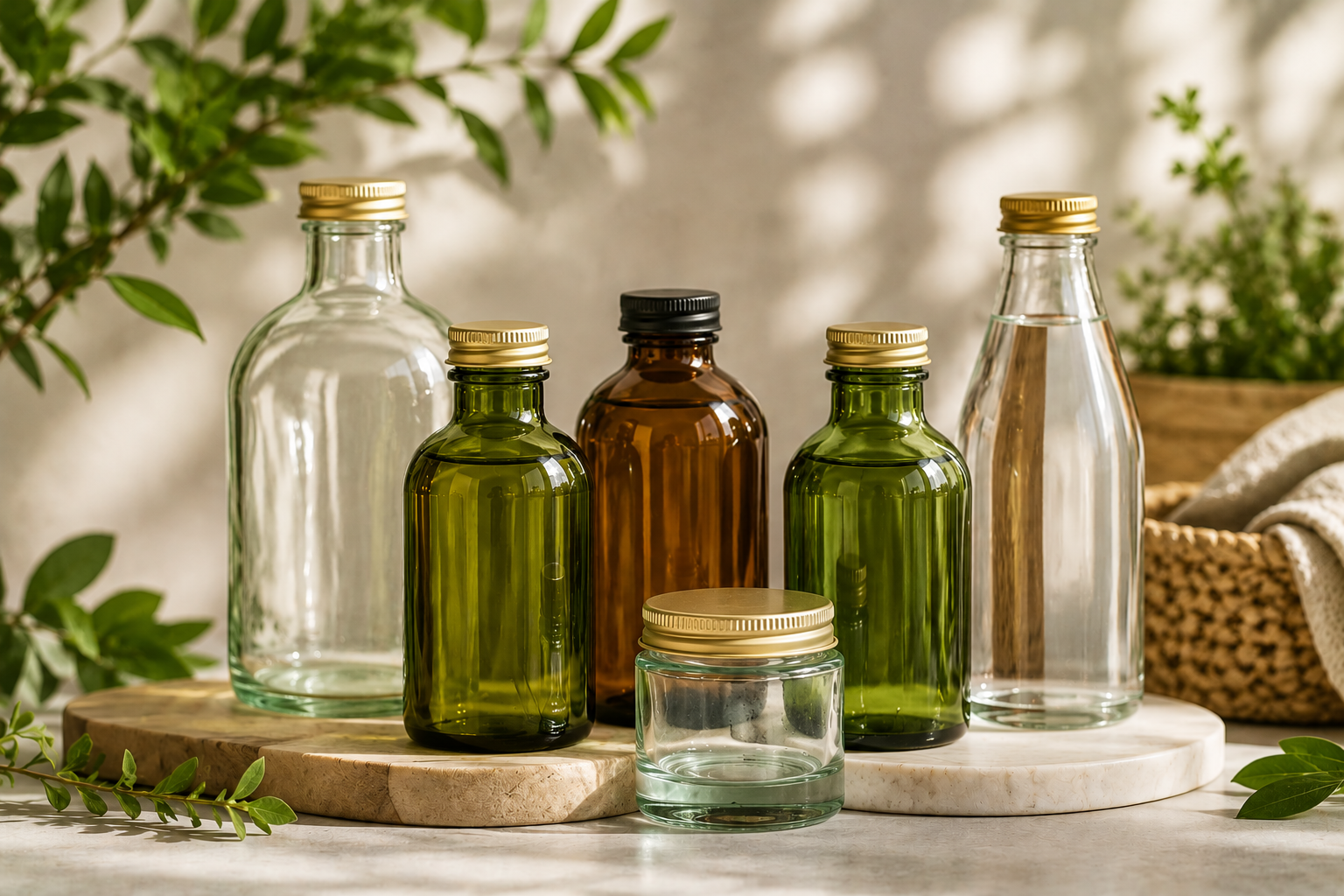
A glass bottles can be used over and over again that is a rare opportunity to have a combination of high quality and functionality. Glass is indicative of quality. It has a heavy weight to hold, it preserves numerous products, and it operates in a variety of categories such as beverages and syrups, fragrances, oils, wellness, and several lines of personal care.
Reuse creates an additional value layer in the case of brands. It is able to reinforce environmental positioning, promote refill systems through which repeat purchases are promoted, and develop a unique customer experience. Even in certain categories, the bottle as such becomes a product identity. The reason why customers retain it, sell it or refill it is because it appears and feels worth preserving.
What makes a glass bottle truly reusable
Not every glass bottle is reusable in a practical commercial sense. A bottle may technically be refillable once or twice, but that does not mean it is suitable for a repeat-use brand program.
A truly reusable glass bottles needs to perform across five dimensions:
1. Structural strength
The bottle must be strong enough to withstand as many times as possible to fill it, handle it, transport it, wash it, and store it without being broken or cracked.
2. Surface durability
The bottle must be able to resist physical damage that is visible like scuffing and scratches, abrasions and clouding that are destructive in the presentation of brands.
3. Cleanability
The bottle shape, neck finish, internal geometry, and ornament all should be able to be effectively cleaned and checked.
4. Product compatibility
The bottle must remain suitable for the formula or beverage it carries, even after repeated wash and reuse cycles.
5. System compatibility
The bottle should work within the brand’s return, refill, washing, sorting, and redistribution model.
This is where many brands make a costly mistake: they evaluate the bottle as an isolated object instead of evaluating the bottle as part of an operating system.
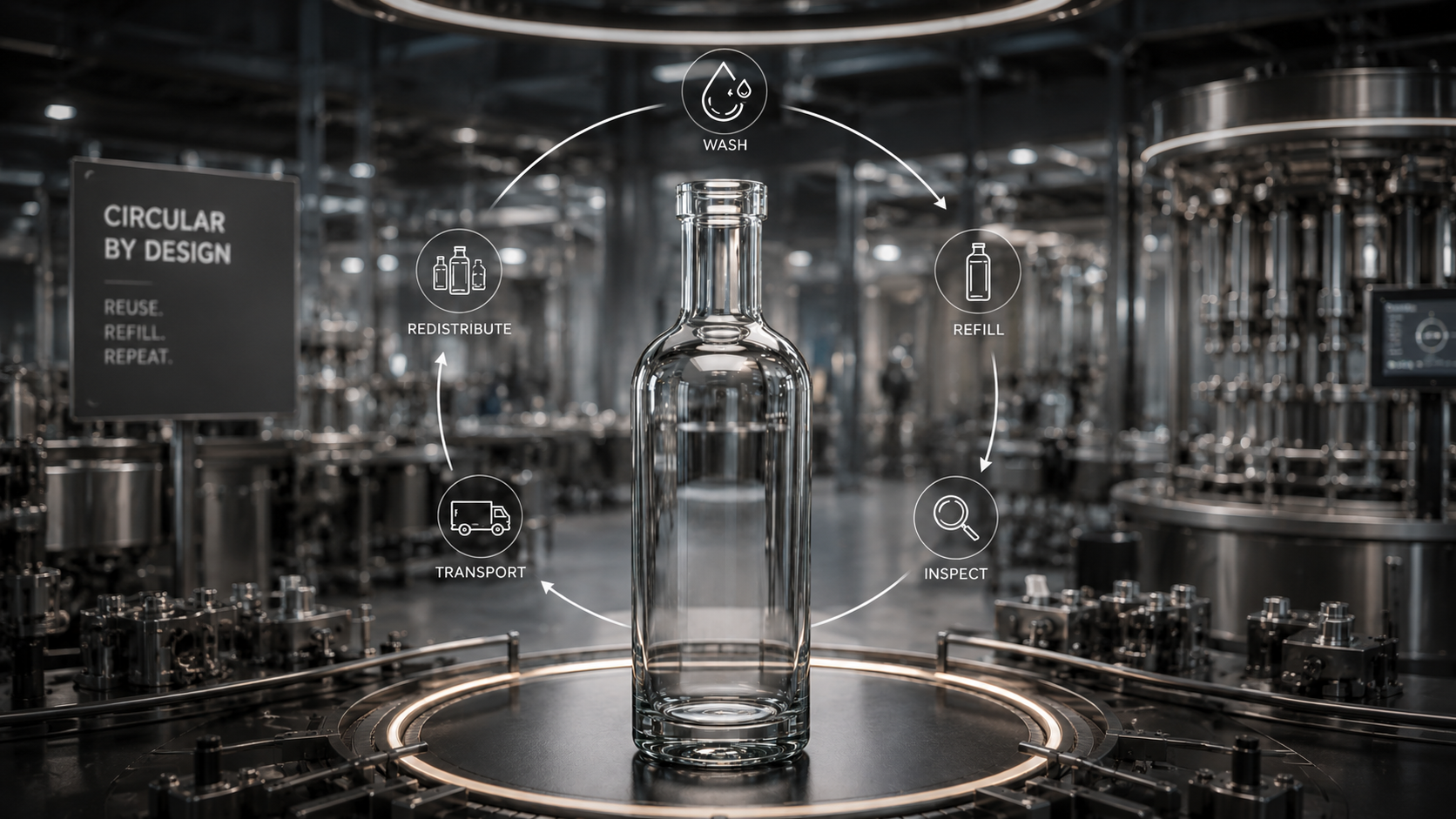
Cleaning considerations for reusable glass bottle programs
The first big technical issue is normally cleaning. It has a direct influence on the safety of the product, customer confidence, shelf life and exposure to the regulatory environment.
The reused bottle with no controlled cleaning method may pose a risk of contamination, odor remnants, residues, and appearance. Glasses that are chemically stable may contain residues of the previous occupant, detergents, closures, adhesives, or exposure to the environment, be it rain or sun, and thus weaken the next fill.
The goal of cleaning is not just “looks clean”
Brands often talk about cleaning as a visual issue, but that is only one part of the picture. A proper reusable glass bottle cleaning process should address:
- Product residue removal
- Microbial risk reduction where relevant
- Odor removal
- Label and adhesive removal
- Foreign particle elimination
- Surface and finish protection
- Consistent inspection before refill
The exact standard depends on what the bottle is used for. Beverage, personal care, fragrance, home care, and pharmaceutical-adjacent categories have different risk profiles.
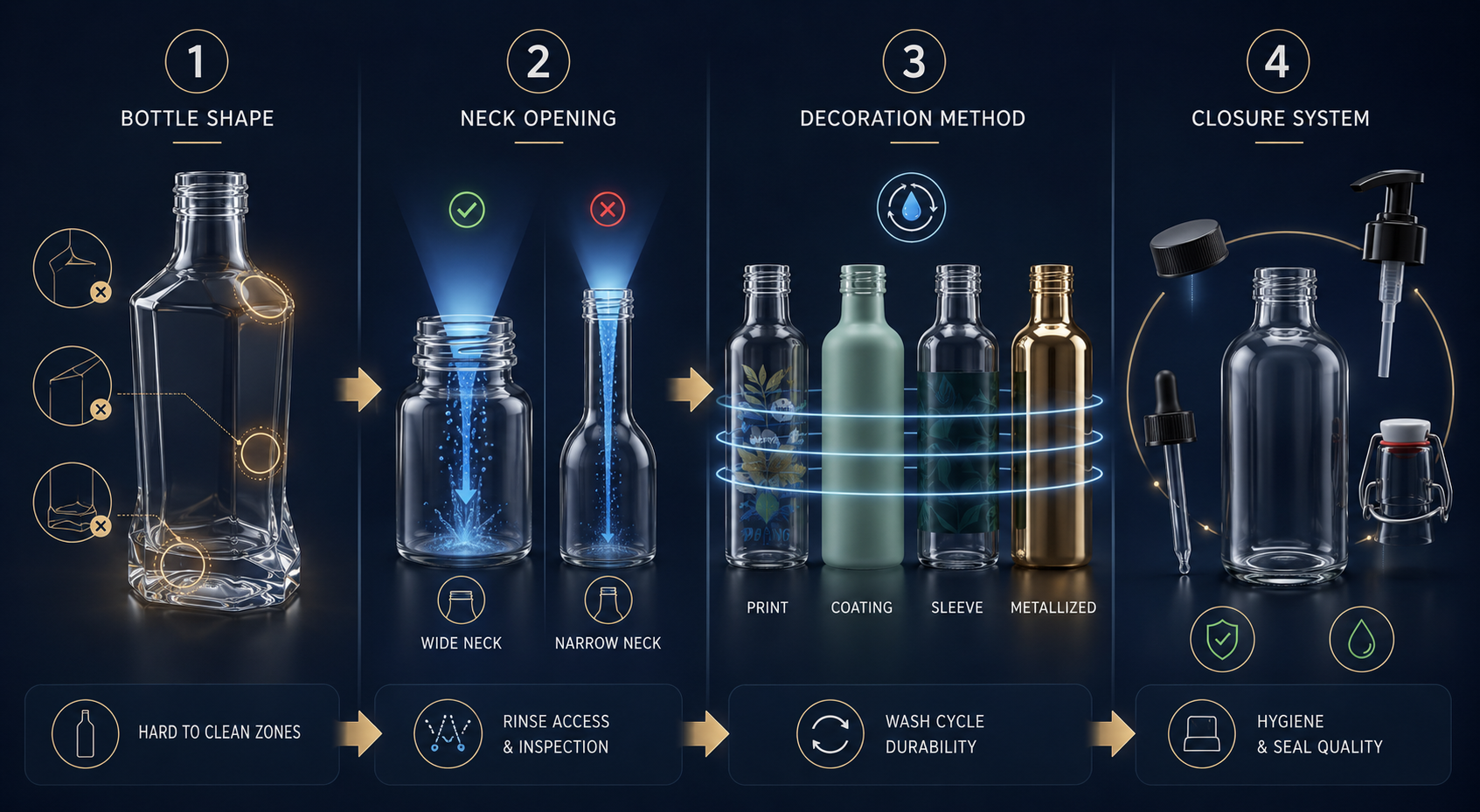
Key variables that affect cleanability
Bottle shape
Complex shoulders, narrow necks, embossed interiors, sharp corners, or unusual bases may look distinctive but can make cleaning harder. Brand teams often prioritize design differentiation early, then discover that the shape complicates automated washing or inspection.
Neck opening
A wider opening typically improves rinse access, visual inspection, and residue removal. Very narrow openings may require more specialized equipment and more stringent process control.
Decoration method
Direct printing, coatings, sleeves, labels, metallization, and embossing all respond differently to repeated washing. What survives one cycle may not survive ten.
Closure system
Closures can affect contamination risk and reuse practicality. Some caps are more suitable for repeated use than others. In many cases, brands reuse the glass bottles but replace the closure to reduce risk and maintain sealing performance.
Common cleaning methods
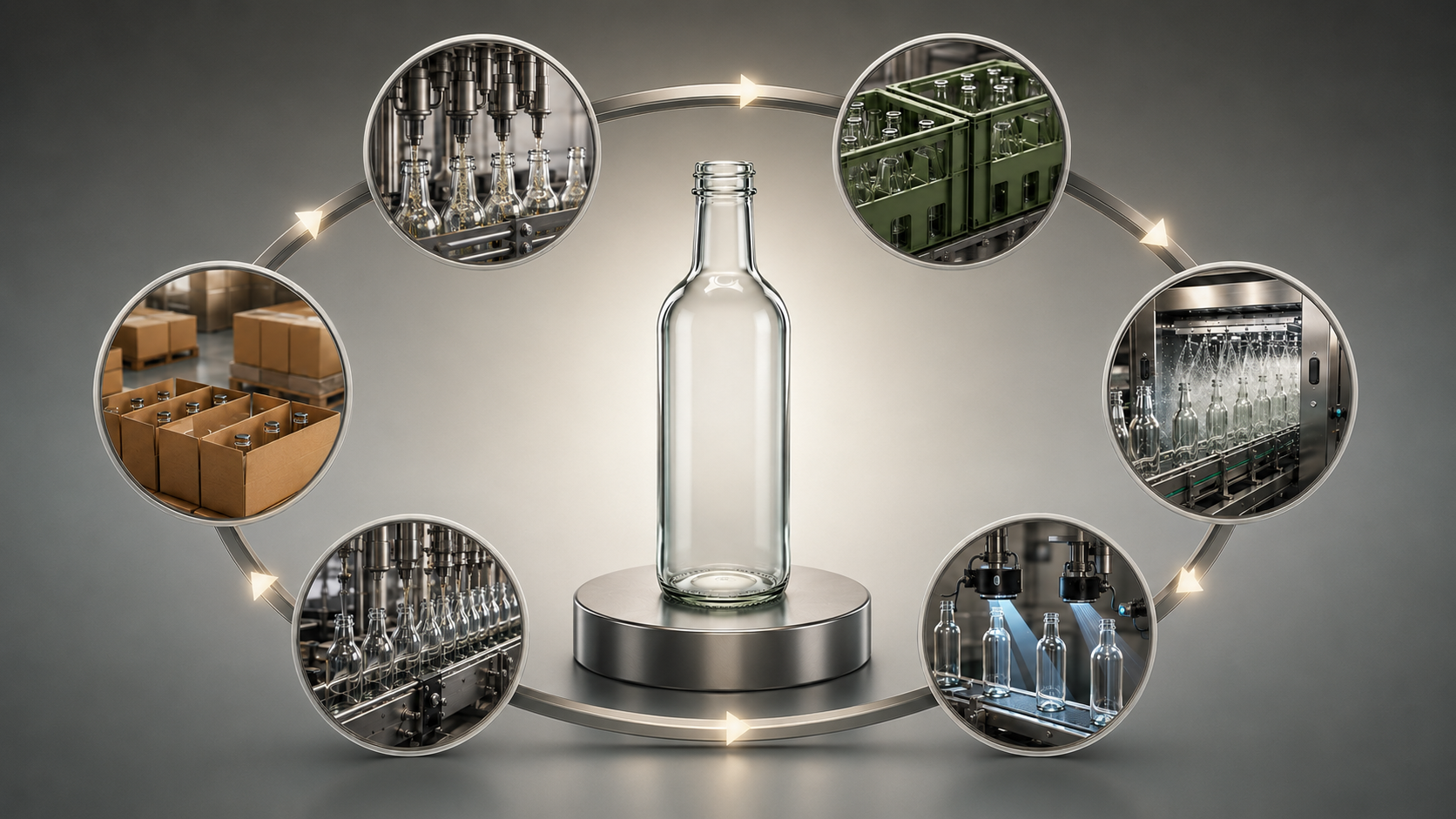
Reusable glass systems can involve a mix of manual, semi-automatic, or industrial cleaning methods depending on scale.
Manual washing
Best for low-volume, controlled, premium, or pilot programs. Manual cleaning gives flexibility but can introduce inconsistency if operators do not follow standard procedures.
Semi-automatic bottle washing
Useful for growing brands that need more consistency without a full industrial returnable-line setup. This approach can improve process control while keeping investment manageable.
Industrial automated washing
Common in large-scale returnable beverage systems. These setups often support controlled temperature, detergent concentration, rinse stages, and inspection integration.
The right approach depends on volume, product sensitivity, labor capacity, and the complexity of the bottle design.
Durability considerations brands cannot ignore
Durability is not only about whether a bottle breaks. It is about how the glass bottle performs across repeated handling while still meeting functional and visual expectations.
A premium-looking package loses value fast if reused bottles arrive with scratches, label damage, chipped finishes, or inconsistent appearance. Durability is therefore both a technical issue and a branding issue.
Types of durability that matter in a reusable glass bottles
Impact resistance
The bottle must withstand drops, knocks, and contact during collection, sorting, washing, and redistribution.
Thermal resistance
If bottles are exposed to hot-fill conditions, warm washing, or temperature changes, thermal performance matters.
Abrasion resistance
Repeated contact with other glass bottle, crates, conveyors, or wash systems can dull the surface or damage decoration.
Closure-area integrity
Neck finish and threading performance must remain reliable after repeated capping and uncapping.
Base and sidewall performance
These areas often experience repeated stress in transport and wash-line handling.
Design factors that affect durability
Glass thickness and weight
Heavier is not always better, but underbuilt glass bottle often fail in reuse models. The right specification balances durability, handling efficiency, and shipping economics.
Bottle geometry
Round, well-balanced bottles can perform differently from sharply contoured or asymmetrical designs. Distinctive shapes may be brand-enhancing, but they require testing.
Surface treatment and finish
Protective coatings or treatments may help reduce scuffing and improve performance in circulation.
Decoration choice
Screen printing, embossing, labeling, frosting, and coatings each behave differently over time. Decoration should be tested across the intended number of reuse cycles.
Logistics format
The same bottle can perform well in one supply chain and poorly in another. Crates, dividers, palletization, transport distances, and handling discipline all influence breakage rates.
Compliance considerations for reusable glass bottle programs
Compliance is where many promising packaging ideas slow down. Not because glass is inherently problematic, but because reuse adds operational and documentation requirements that brands must take seriously.
The exact rules depend on the country, product category, and sales channel. A beverage bottle, a cosmetic bottle, and a pharma-related bottle can fall under very different expectations. But the broad principles are consistent: the packaging must be fit for purpose, safe for intended use, and supported by adequate process control.
Key compliance themes brands should consider
Food or product contact suitability
If the glass bottle is used for consumables or direct-contact products, brands need assurance that the packaging remains suitable throughout intended use.
Cleanliness and hygiene process validation
Where product safety is sensitive, brands may need documented wash procedures, sanitation controls, and refill handling protocols.
Labeling and traceability
If bottles circulate repeatedly, brands may need ways to identify batches, reuse history, or rejection triggers depending on the operating model.
Claims compliance
If the brand markets the bottle as reusable, refillable, sustainable, or circular, those claims should align with actual operational reality.
Market-specific packaging rules
Import/export and regional regulations may shape documentation, material declarations, and testing expectations.
The hidden role of closures, labels, and decoration
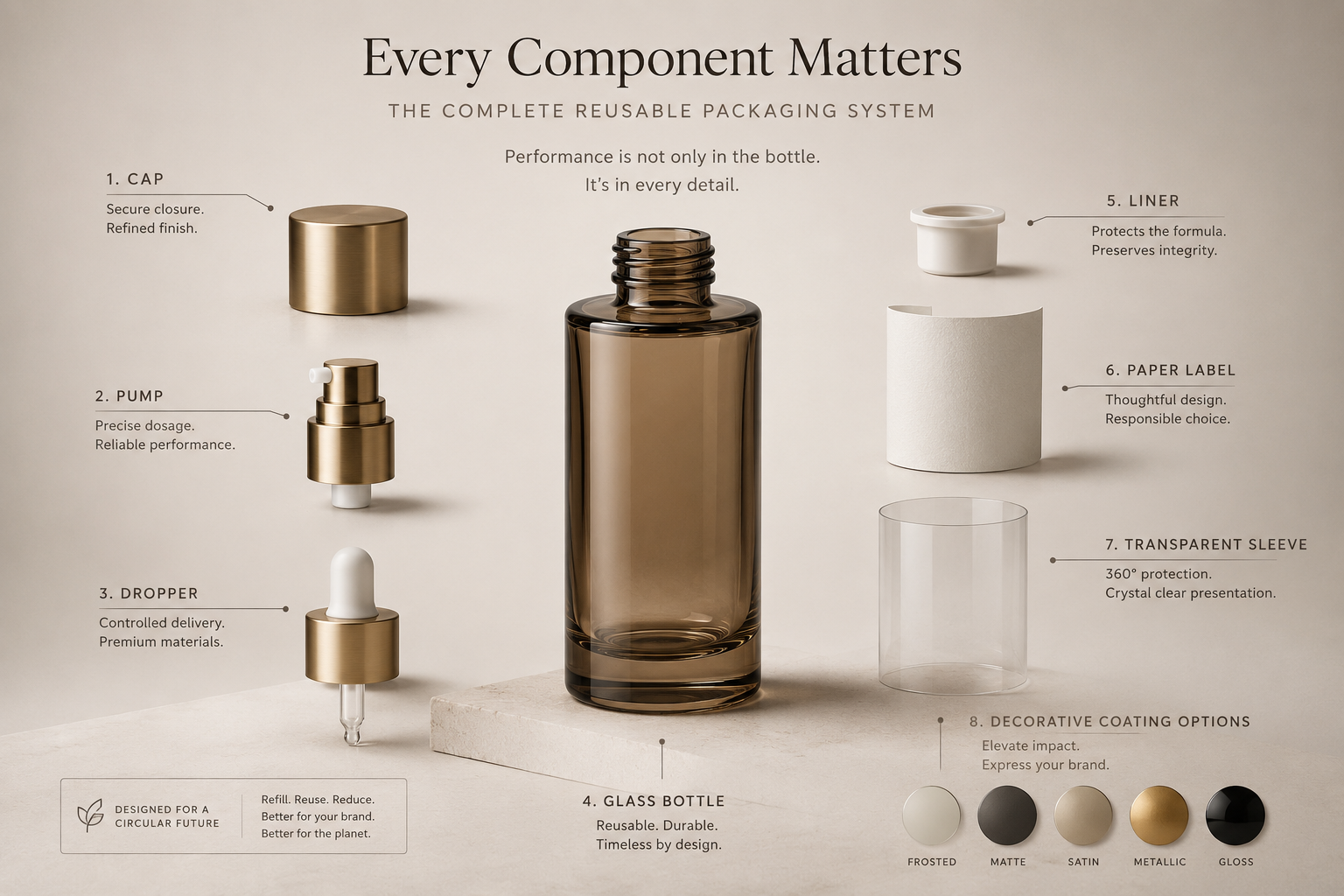
Brands often focus on the glass bottle itself and overlook the surrounding components. But a reusable packaging system is only as strong as the weakest link element.
Closures
Some closures can be reused under certain conditions, but many brands find it safer and more consistent to reuse the bottle while replacing the cap, pump, dropper, liner, or dispensing element. This is especially relevant in categories where hygiene, seal integrity, or product contamination risk is high.
Labels
Paper labels may look premium, but adhesive residue and wash-off behavior need attention. Sleeves and special finishes may complicate sorting or cleaning. Direct printing may improve aesthetics, but repeated wash resistance must be verified.
Decorative coatings
Frosting, color coating, metallic accents, and premium finishes can support brand positioning, but they can also become a failure point in reuse cycles. Premium branding should be tested under practical conditions, not judged only by first-fill appearance.
For many brands, the right answer is not “maximum decoration.” It is “the highest premium look that still performs reliably in the intended reuse model.”
How brands should build a reusable glass bottle program
A successful reuse program is built like an operating model, not a packaging trend experiment.
A numbered process brands can follow
1. Clarify the business objective
Decide whether the goal is sustainability positioning, refill revenue, premium differentiation, waste reduction, cost-per-cycle improvement, or all of the above.
2. Choose the right glass bottle format
Select a bottle shape and specification that balances brand aesthetics, cleanability, and durability.
3. Define the reuse pathway
Will customers return bottles? Will retail partners collect them? Will bottles be refilled on site or centrally?
4. Test packaging performance
Run washing, filling, logistics, and appearance tests over repeated cycles.
5. Decide component strategy
Determine what gets reused and what gets replaced, including caps, pumps, droppers, labels, and cartons.
6. Build SOPs
Create standard operating procedures for sorting, washing, drying, inspection, rejection, and refilling.
7. Validate claims and compliance
Ensure product-contact suitability, instructions, records, and marketing claims align with the actual program.
8. Pilot in a controlled channel
Start small with a manageable market, customer segment, or product line.
9. Measure outcomes
Track return rate, breakage, cleaning success, rejection rate, customer satisfaction, and cost per successful reuse.
10. Scale with evidence
Expand only after the operational model proves it can maintain quality and economics.
Ajanta Bottle: Packaging That Feels as Good as It Looks
At Ajanta Bottle, we believe every great fragrance deserves a bottle that captures its essence at first glance. With over four decades of packaging expertise, we help perfume brands turn their vision into packaging that speaks, sells, and stays memorable.
From color psychology consultation to premium decoration techniques such as gradient coating, frosting, UV printing, and embossing, we offer end-to-end solutions tailored to your scent, story, and strategy. Whether you’re creating a minimalist niche collection or launching a vibrant festive edition, our team will help you choose the right color palette, cap style, and finishing detail to ensure your product stands out on the shelf and in the heart.
Your perfume is more than a product. It is a story, a memory, an emotion. Let us help you bottle that story beautifully.
Ready to create the perfect glass bottle packaging for your brand?
Connect with us: ● Email at sales@ajantabottle.com ● Phone/Whatsapp: +91 9891098918
You can also shop from more than 500+ packaging solutions on www.ajantabottle.com – India’s first ever comprehensive packaging e-commerce portal.
For additional information, browse through our blog at https://www.ajantabottle.com/public/blog/or subscribe to our latest updates through our social media channels,
YouTube channel: https://www.youtube.com/c/Ajantabottle
LinkedIn Page: https://www.linkedin.com/company/ajantabottle
Facebook Page: https://www.facebook.com/glassbottleindia
Instagram Page: https://www.instagram.com/ajantabottle
Google Business Profile Manager: https://g.page/r/CXTH9MKpe2DuEBM/review