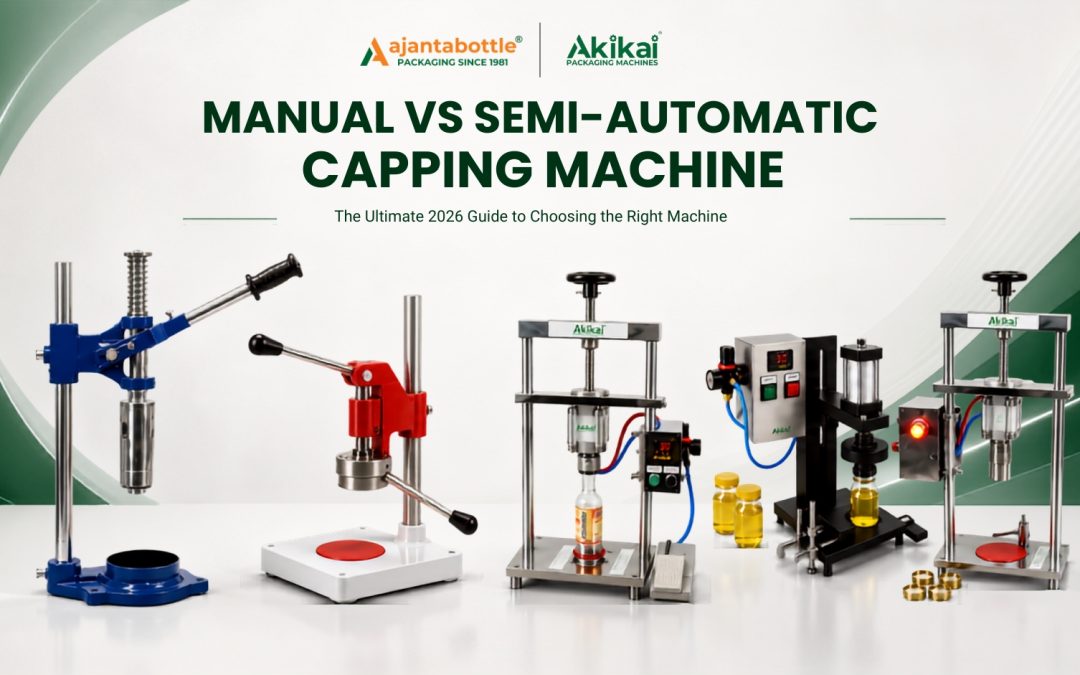
Not only does a small food brand or cosmetics brand have to fill a bottle and then seal it when it involves packaging. The final cap will determine if the product gets to the customer safely, looks good on the shelf, and functions well during storage, transit and every day use.
Hence, it is essential to consider the right capping machine as a serious business decision.
Loose cap may leak. If it becomes so tight, it can cause damage to the neck, thread, pump, dropper or cap closure. When caps are inconsistent, it may affect product quality, customers’ trust and reorder. Proper capping solution is beneficial to brands, particularly in the beverages, cosmetic, essential oil, serum, perfume and wellness markets for boosting speed, uniformity, and production confidence.
Thus, the question arises as to what type of capping machine to choose: manual or semi-automatic capping machine?
It is all dependent on the production volume, cap type, budget, labour availability, packaging format, and the growth plans. This guide will support small brands make a sensible, scalable choice.
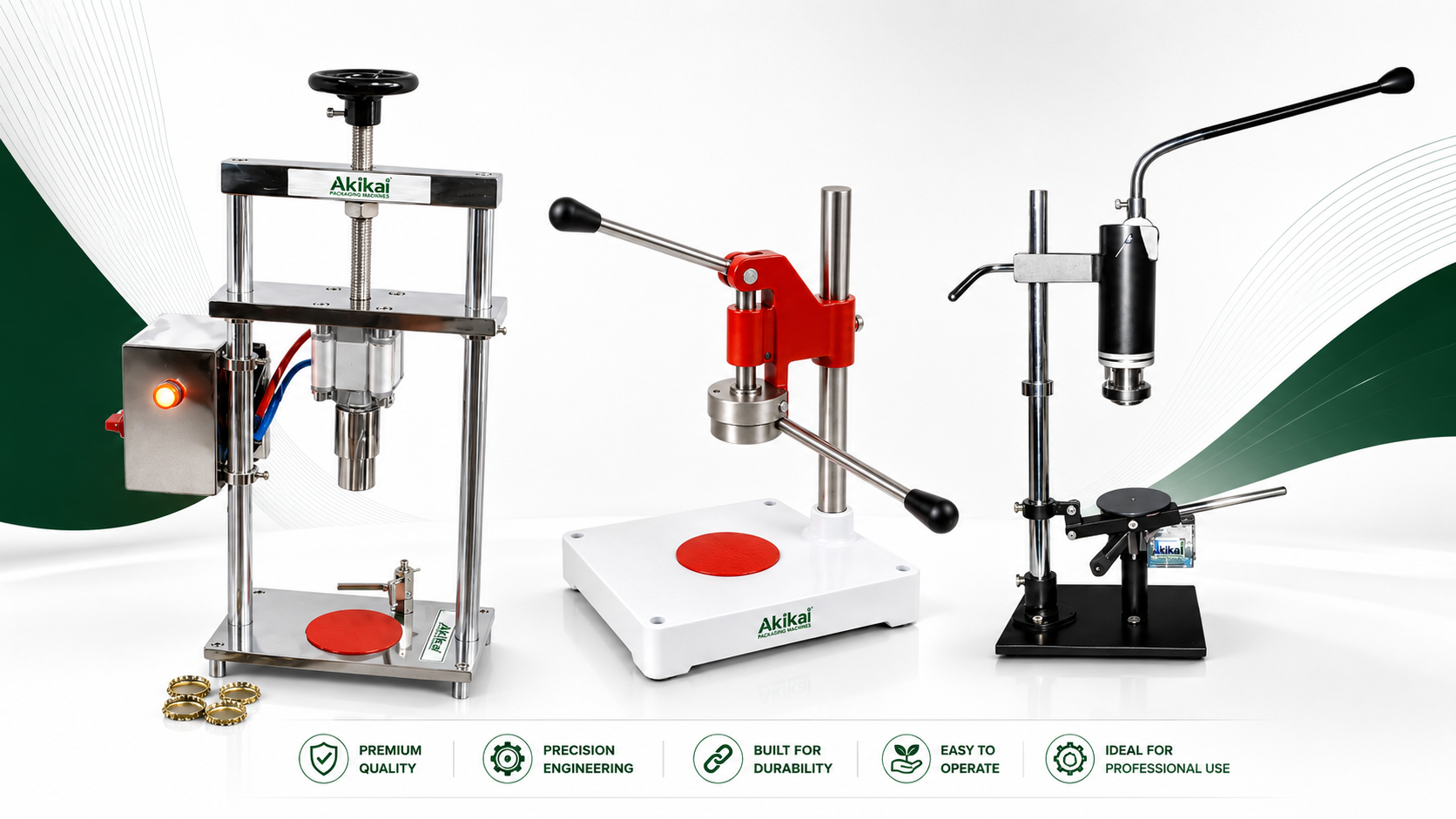
What Is a Capping Machine?
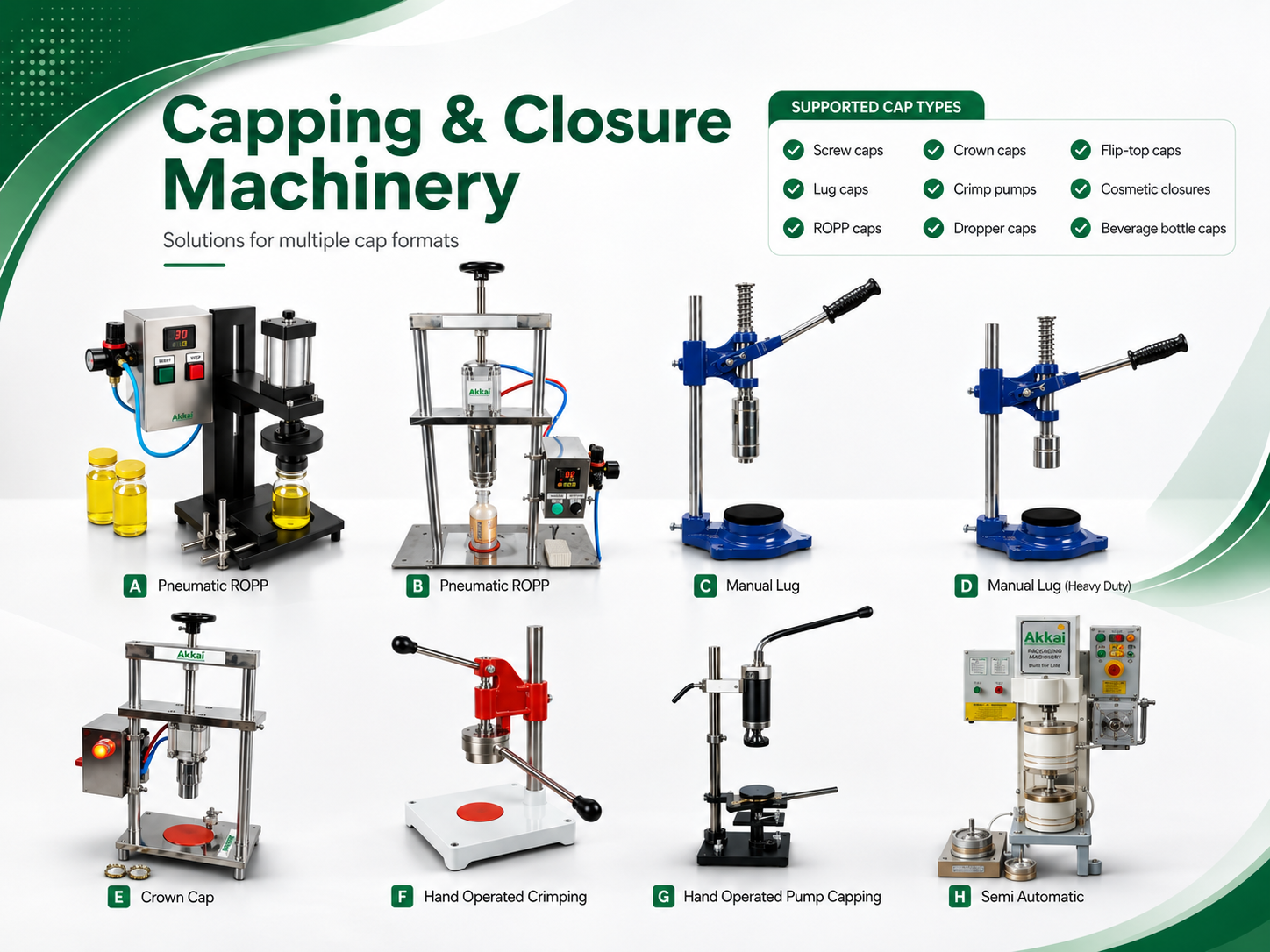
Packaging equipment used for applying, tightening, sealing or crimping caps on bottles, jars, containers and other packaging formats are called capping machines.
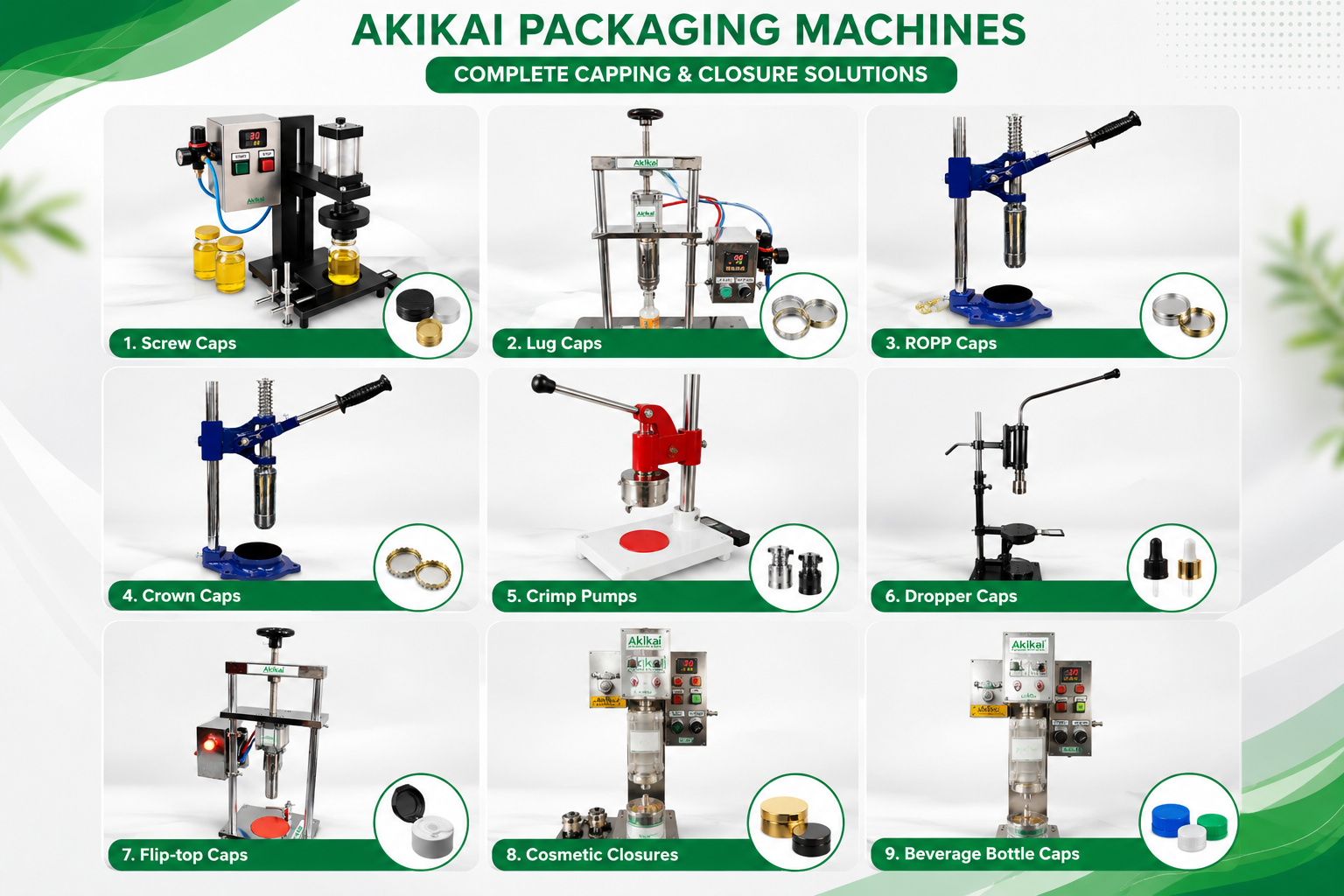
A capping machine can be used for the following:
- Screw caps
- Lug caps
- ROPP caps
- Crown caps
- Crimp pumps
- Dropper caps
- Flip-top caps
- Cosmetic closures
- Beverage bottle caps
A capping machine is a packaging machine that is used to cap, tighten, seal or crimp caps onto bottles, jars, packaging containers and other packaging formats.
Cap machines are advantageous for small and medium-sized brands to lessen manual work, ensure packaging quality uniformity, and enhance the production workflow. It is observed that packaging machinery typically performs a variety of filling, capping, sealing, labelling and testing functions, and Akikai’s positioning of machinery for mid-scale packaging operations is consistent with this.
Why Capping Quality Matters for Beverage and Cosmetic Brands
Capping is a critical operation in packaging. When the bottle, formulation, label and outside packaging are top of the line, the capping can cause problems.
Poor capping can cause leakage, carbonation issues, failure to meet minimum quality standards and associated risk of contamination, shipping damage, or batch rejection for beverage companies.
Inconsistent sealing may impact cosmetics safety, dispensing ability, appearance and satisfaction. This is particularly crucial for serums, oils, lotions, perfumes, creams, and cosmetics that are liquid.
Indian beauty and personal care market is becoming competitive as online beauty purchasing activities are gaining momentum and brands are making a quick entry into the market. Beauty e-commerce and quick-commerce orders rose by 39% in value from June to November 2024 over the same period the previous year, highlighting the agility required for beauty brands these days to launch, restock and ensure packaging reliability.
When it comes to packaging efficiency in this kind of a market, it’s a must. It is a growth promoter.
What Is a Manual Capping Machine?
Packaging equipment used for applying, tightening, sealing or crimping caps on bottles, jars, containers and other packaging formats are called capping machines.
Manual capping machines are commonly used by:
- Startups
- Homegrown cosmetic brands
- Small beverage producers
- Trial-batch manufacturers
- R&D labs
- Sampling units
- Low-volume production setups
Manual machines are attractive because they are affordable, easy to operate, and suitable for limited production volumes.
Advantages of Manual Capping Machines
1. Lower Initial Investment
Manual capping machines are usually more budget-friendly than semi-automatic machines. For early-stage brands, this helps reduce upfront machinery cost.
2. Easy to Operate
Manual machines usually require minimal technical training. Operators can learn the process quickly, making them suitable for small teams.
3. Good for Trial Batches
If a brand is launching a new beverage, serum, oil, fragrance, or cosmetic product and wants to test market response, a manual capping machine can support limited production.
4. Compact and Space-Saving
Manual machines are generally smaller and easier to place in compact production areas.
5. Suitable for Multiple Small SKUs
For brands working with various bottle sizes and low batch quantities, manual machines may offer sufficient flexibility without necessitating major setup changes.
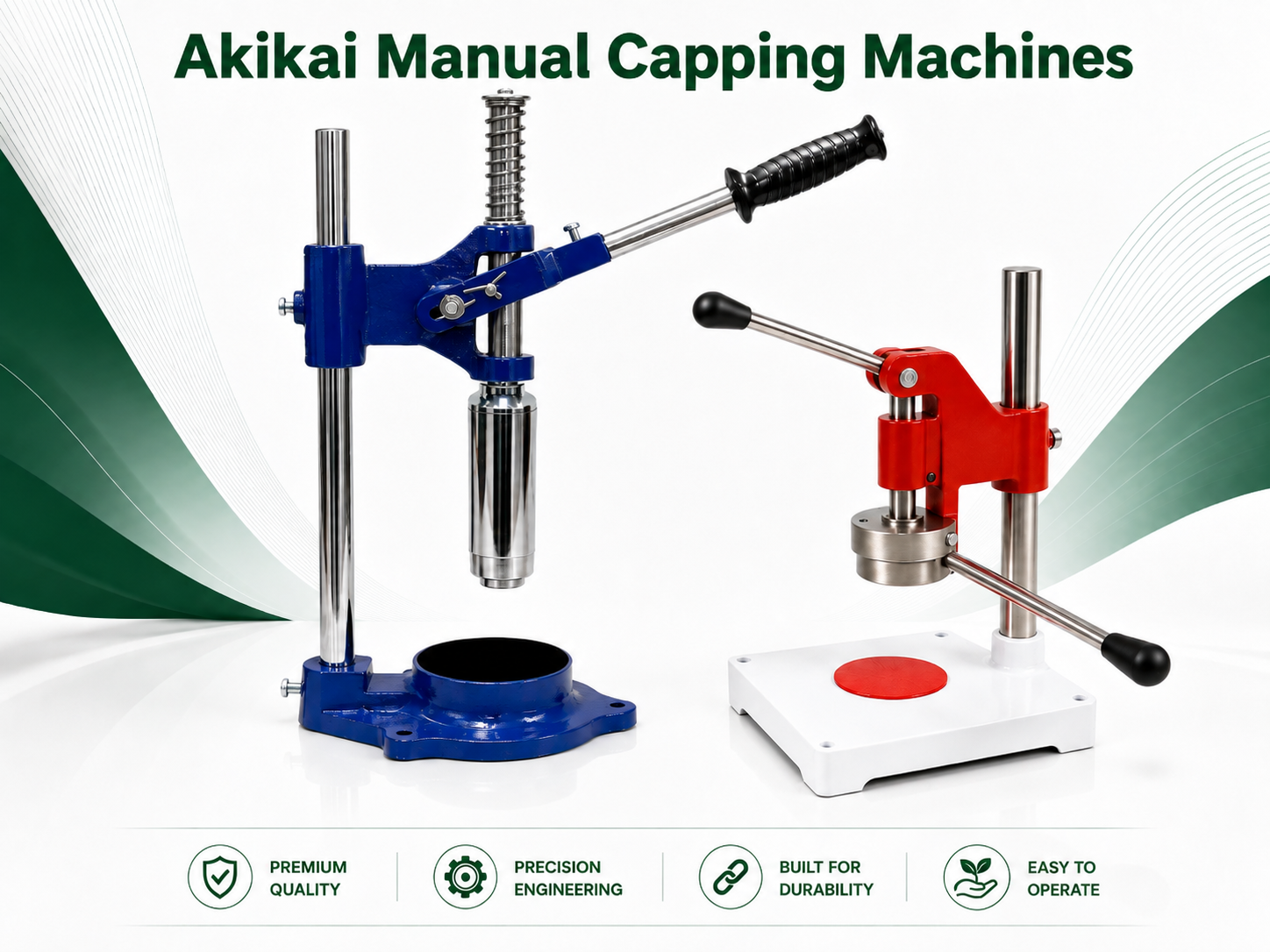
Limitations of Manual Capping Machines
Manual capping is practical for small batches, but it has clear limitations as the brand grows.
1. Lower Speed
Manual operation depends heavily on the operator. As production volume increases, output becomes slower and less predictable.
2. Inconsistent Torque
Every operator may apply different pressure. This can result in some caps being too loose and others being too tight.
3. Higher Labour Dependency
Manual capping requires more physical effort. Over time, operator fatigue can affect productivity and consistency.
4. Not Ideal for Scaling
A manual machine may work for 100 or 300 bottles a day, but it becomes inefficient when a brand needs to produce thousands of bottles regularly.
5. Higher Risk of Rework
Improper capping can lead to leak checks, retightening, product loss, and packaging rejection.
What Is a Semi-Automatic Capping Machine?
A semi-automatic capping machine automates part of the capping process while still requiring an operator to place the bottle, cap, or both. In many semi-automatic models, the operator positions the bottle, and the machine applies controlled torque or sealing pressure.
Semi-automatic capping machines are suitable for brands that need more consistency and speed than manual capping but are not yet ready for a fully automatic production line.
According to GlobalSpec’s capping machine guide, semi-automatic capping machines allow a single operator to perform routine capping activities quickly and accurately, while automatic machines require much less operator involvement.
Advantages of Semi-Automatic Capping Machines
1. Better Capping Consistency
Semi-automatic machines offer more controlled torque and repeatability compared to manual capping. This reduces the chances of loose caps, over-tightened caps, leakage, and cap damage.
2. Higher Production Speed
A semi-automatic capping machine can improve daily output significantly, especially for brands moving from trial batches to regular commercial production.
3. Reduced Operator Fatigue
Because the machine handles the tightening or sealing action, the operator does not need to apply continuous manual force.
4. More Professional Packaging Output
Consistent capping improves the final look and feel of the product. For cosmetics, perfumes, beverages, and premium personal care products, this directly supports brand perception.
5. Suitable for Growth-Stage Brands
Semi-automatic machines are ideal for brands that have recurring orders, distributor demand, online sales, or retail expansion.
6. Strong Balance of Cost and Efficiency
For many small and mid-sized brands, semi-automatic machinery offers a practical middle path between low-cost manual machines and high-investment automatic lines.
Ajanta’s internal strategic material also recognises Akikai’s machinery venture under Ajanta Bottle and references semi-automatic capping machinery as part of its packaging machinery offering, with machinery positioned as a practical route for brands building packaging capability.
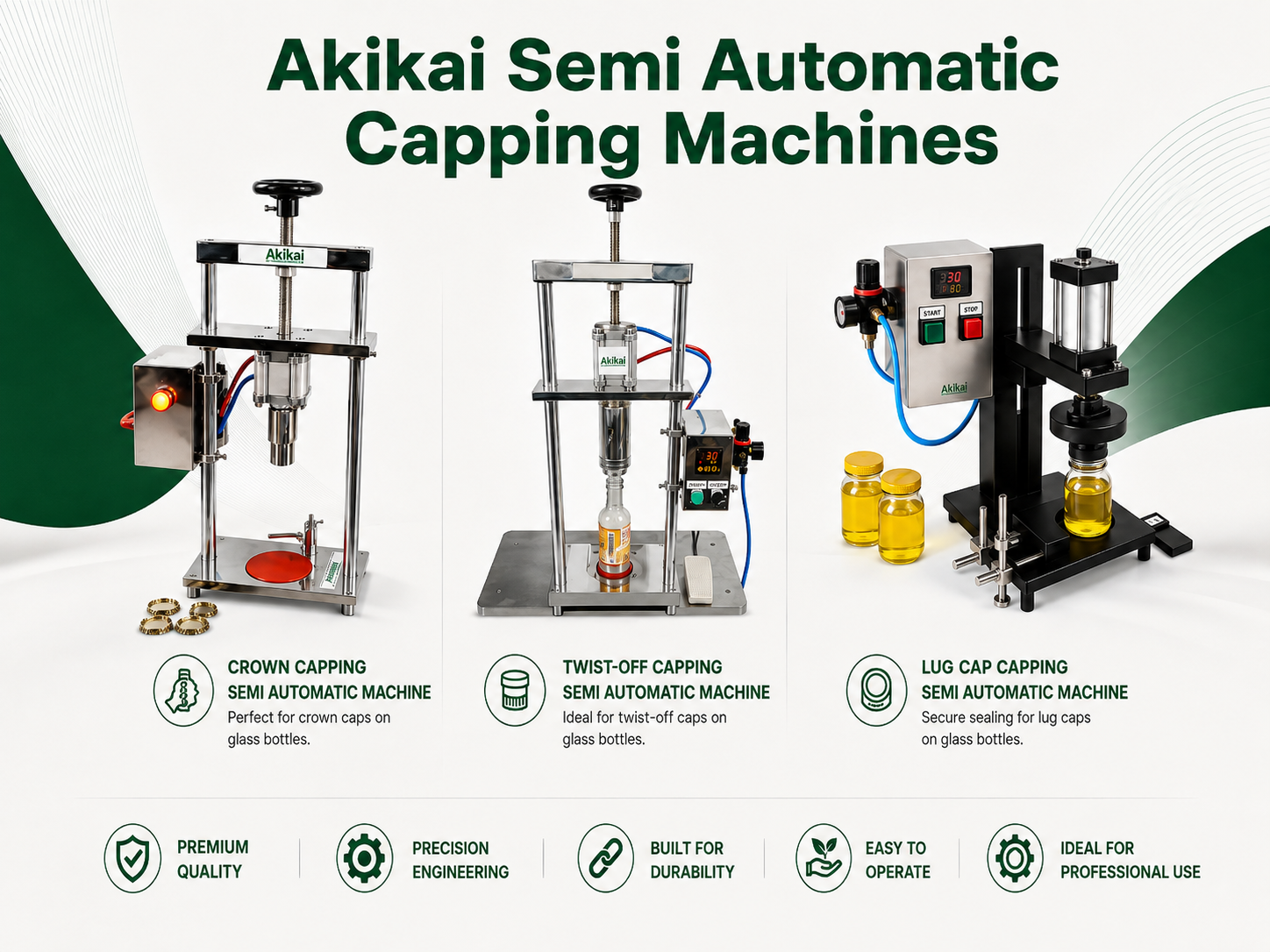
Limitations of Semi-Automatic Capping Machines
1. Higher Cost Than Manual Machines
Semi-automatic machines require a higher initial investment. However, the cost may be justified when production volumes, labour savings, and reduced rejection rates are considered.
2. Requires Basic Operator Training
Operators need to understand machine settings, cap placement, bottle positioning, and safety practices.
3. May Need Power or Compressed Air
Depending on the machine type, a semi-automatic capping machine may require electricity or pneumatic support.
4. Not a Full Replacement for Automatic Lines
For very high-volume production, a fully automatic capping line may eventually be required. However, semi-automatic machines are often the right bridge for growing brands.
Manual vs Semi-Automatic Capping Machine: Key Difference
| Factor | Manual Capping Machine | Semi-Automatic Capping Machine |
| Best for | Very small batches, sampling, startups | Growing brands, regular production |
| Speed | Low to moderate | Moderate to high |
| Consistency | Operator-dependent | More controlled and repeatable |
| Labour effort | Higher | Lower |
| Investment | Lower | Higher than manual |
| Scalability | Limited | Better for growth |
| Torque control | Basic or manual | More precise |
| Rework risk | Higher | Lower |
| Ideal users | Trial-stage brands | Small to mid-scale commercial brands |
Which Capping Machine Is Best for Small Beverage Brands?
For beverage brands, the right capping machine depends on bottle type, closure style, and production volume.
Manual capping may be suitable if the brand is producing small trial batches of juices, syrups, mocktails, health drinks, or specialty beverages.
However, semi-automatic capping becomes more practical when the brand starts handling regular production, distributor orders, or retail supply. Beverages often face transport movement, stacking pressure, leakage risks, and shelf-life concerns. A more consistent capping process helps improve product safety and buyer confidence.
For small beverage brands, choose a semi-automatic capping machine if:
- You produce daily or weekly batches
- You supply to retailers, cafés, hotels, or distributors
- Leakage complaints are a concern
- You use glass bottles or premium beverage packaging
- You want faster output without a fully automatic line
- Your team needs repeatable sealing quality
Packaging demand in India continues to grow, with IBEF noting that India’s packaging industry was valued at US$84 billion in 2024 and projected to reach US$143 billion by 2029. This growth supports the need for better packaging infrastructure among emerging brands.
Which Capping Machine Is Best for Small Cosmetic Brands?
Cosmetic packaging often carries higher expectations around finish, hygiene, precision, and brand presentation. A serum bottle, essential oil bottle, lotion bottle, perfume bottle, or cream jar must not only close properly but also look premium and feel reliable in the customer’s hand.
Manual capping can work for early-stage cosmetic startups, especially during product testing or influencer sampling.
But for commercial cosmetic production, a semi-automatic capping machine is usually the better choice because it supports consistency, reduces hand fatigue, and improves output quality.
For cosmetic brands, choose a semi-automatic capping machine if:
- You sell serums, oils, lotions, perfumes, or liquid cosmetics
- You work with droppers, pumps, screw caps, or crimp closures
- Your packaging needs a premium finish
- You want fewer leakage and closure complaints
- You are scaling from small-batch to regular production
- You supply marketplaces, salons, retailers, or distributors
Cosmetic brands also benefit from packaging systems where bottles, closures, decoration, and machinery are considered together. Ajanta’s portfolio includes glass bottles, closures, decoration capabilities, and packaging machinery building blocks, supporting a system-based packaging approach for premium brands.
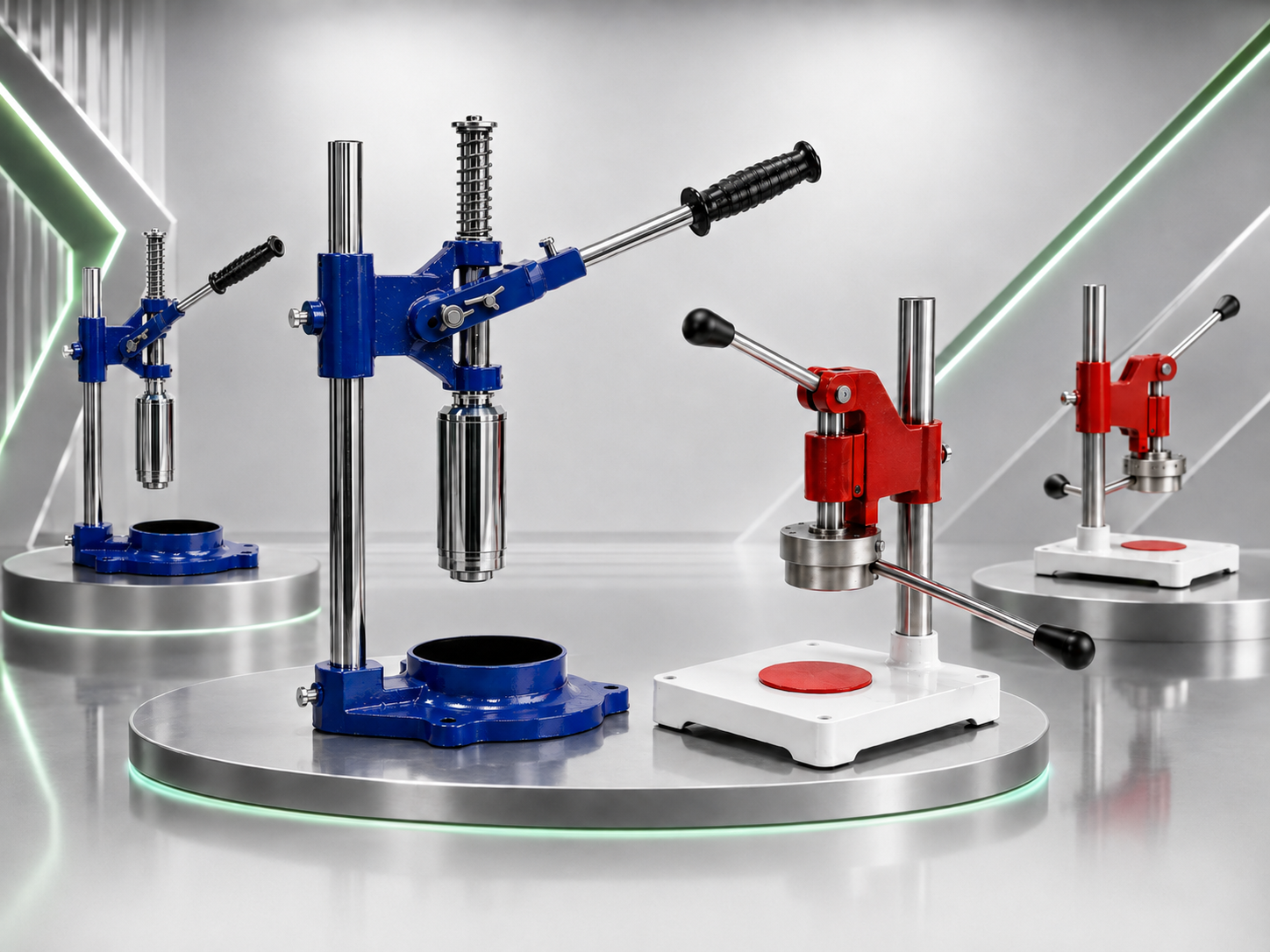
When Should You Choose a Manual Capping Machine?
A manual capping machine is a good choice when your brand is still in the early stage and production volumes are low.
Choose manual if:
- You produce small batches only
- Your budget is very limited
- You are testing a new product
- Your team has enough time for slower production
- You do not yet have regular bulk orders
- Your cap type is simple
- You want basic machinery before investing further
Manual capping is best seen as an entry-level solution. It helps brands move away from fully hand-tightened caps, but it is not ideal for long-term scaling.
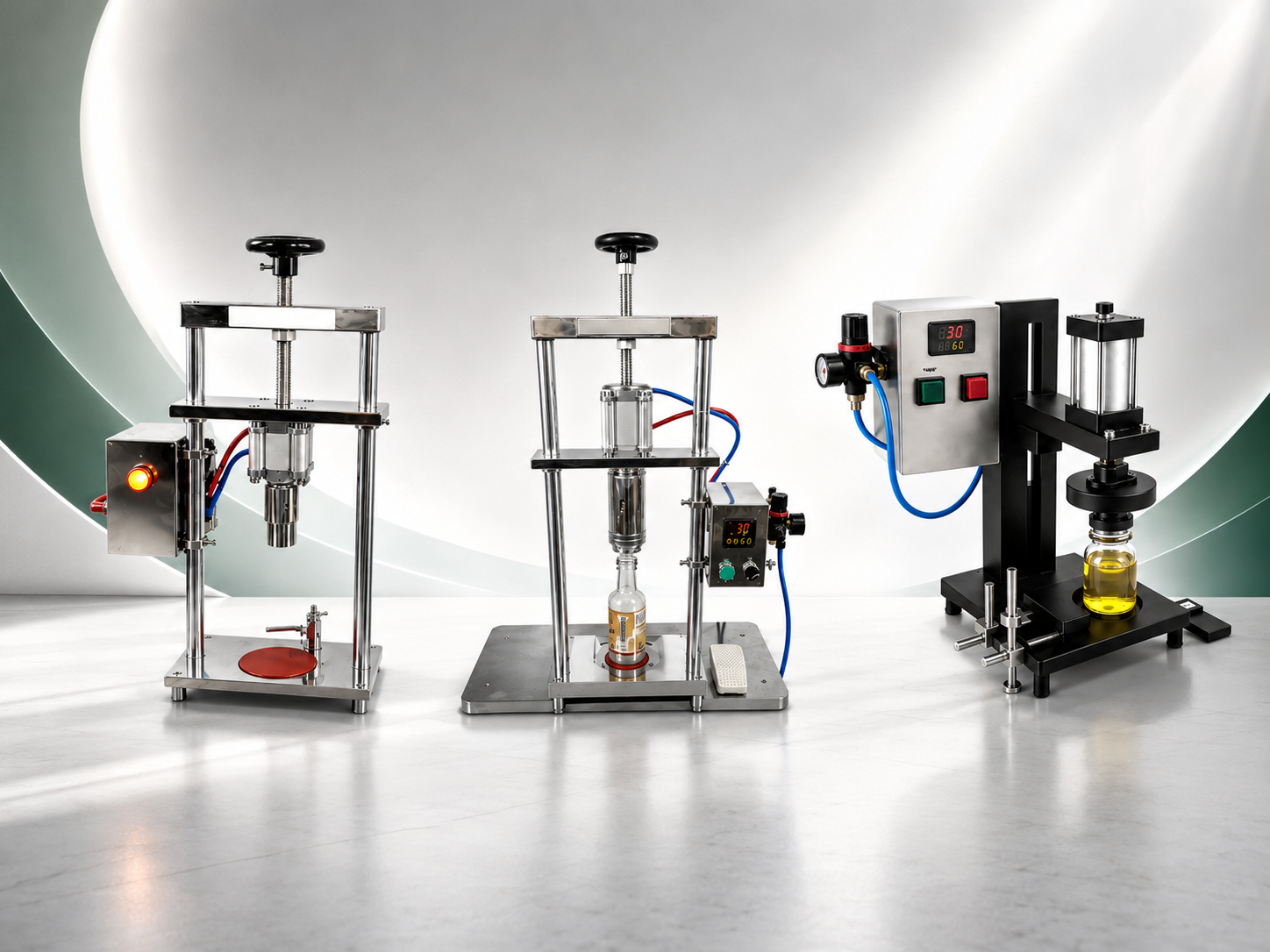
When Should You Choose a Semi-Automatic Capping Machine?
A semi-automatic capping machine is the better choice when your brand is ready for more structured production.
Choose semi-automatic if:
- You have repeat orders
- You produce hundreds or thousands of bottles
- You need better torque consistency
- You want to reduce labour fatigue
- You are receiving leakage or closure complaints
- You plan to expand into retail or e-commerce
- You want a more professional packaging workflow
- You need a machine that supports growth without full automation
Semi-automatic machines are especially useful for brands that want to improve productivity without taking on the cost, space, and complexity of a fully automatic line.
Cost vs Value: Don’t Look at Machine Price Alone
Many small brands compare machines only by purchase cost. This can lead to the wrong decision.
Instead, evaluate the total business impact.
A cheaper manual capping machine may seem attractive, but if it slows production, increases labour dependency, causes inconsistent sealing, or leads to rework, the real cost becomes higher.
A semi-automatic capping machine may cost more upfront, but it can support:
- Faster production
- Better consistency
- Lower rejection risk
- Reduced operator fatigue
- Improved packaging finish
- Better customer satisfaction
- Higher readiness for bulk orders
For a growing brand, the right question is not: “Which machine is cheaper?”
The better question is: “Which capping machine will support reliable growth?”
Conclusion: Choose the Machine That Matches Your Growth Stage
The best capping machine is not the most expensive one or the most advanced one. It is the one that fits your current production needs while supporting your next stage of growth.
If your brand is still testing products, producing small batches, or working with limited orders, a manual capping machine may be suitable.
But if you are building a serious beverage or cosmetic brand, handling repeat production, selling through e-commerce or retail, and aiming for consistent packaging quality, a semi-automatic capping machine is the smarter choice.
For growing brands, packaging machinery is not just equipment. It is an investment in efficiency, reliability, presentation, and customer trust.
Ajanta Bottle: 45 Years of Packaging That Builds India’s Shelf Presence
With over 44 years of legacy in the Indian packaging industry, Ajanta Bottle has become more than just a packaging supplier it is a trusted partner to brands looking to scale, differentiate, and lead through design.
From the early days of supplying classic glass containers for pharmaceuticals and household staples to now providing premium glass jars, lightweight bottles, and customized aluminum cans for food and beverage businesses, Ajanta has stayed ahead by understanding what packaging really means in a competitive market.
We have worked with countless Indian brands, both legacy and new-age, helping them:
Launch shelf-ready products with strong first-impression value
Shift from plastic to glass to enhance sustainability and consumer trust
Integrate packaging design with brand stories for premium perception
Optimize for retail stocking, e-commerce delivery, and food service convenience
Our in-house decoration unit, innovative packaging machinery under Akikai, and continuous investment in research and customer education (through platforms like PackSchool) make us uniquely placed to support packaging transformations that matter.
Whether it’s a cold-pressed juice in a sleek amber glass bottle or a handcrafted pickle in a heritage-inspired jar, Ajanta Bottle enables food and beverage brands to lead with packaging that speaks louder than words.
We don’t just supply containers.
We build packaging stories that sell.
Ready to create the perfect glass packaging for your brand?
Connect with us:
● Email at sales@ajantabottle.com
● Phone/Whatsapp: +91 9891098918
You can also shop from more than 500+ packaging solutions on www.ajantabottle.com – India’s first ever comprehensive packaging e-commerce portal.
For additional information, browse through our blog at https://www.ajantabottle.com/public/blog/ or subscribe to our latest updates through our social media channels,
*YouTube channel: https://www.youtube.com/c/Ajantabottle
*LinkedIn Page: https://www.linkedin.com/company/ajantabottle
*Facebook Page: https://www.facebook.com/glassbottleindia
*Instagram Page: https://www.instagram.com/ajantabottle
*Google Business Profile Manager: https://g.page/r/CXTH9MKpe2DuEBM/review